The Dead Tree of Christmas Past
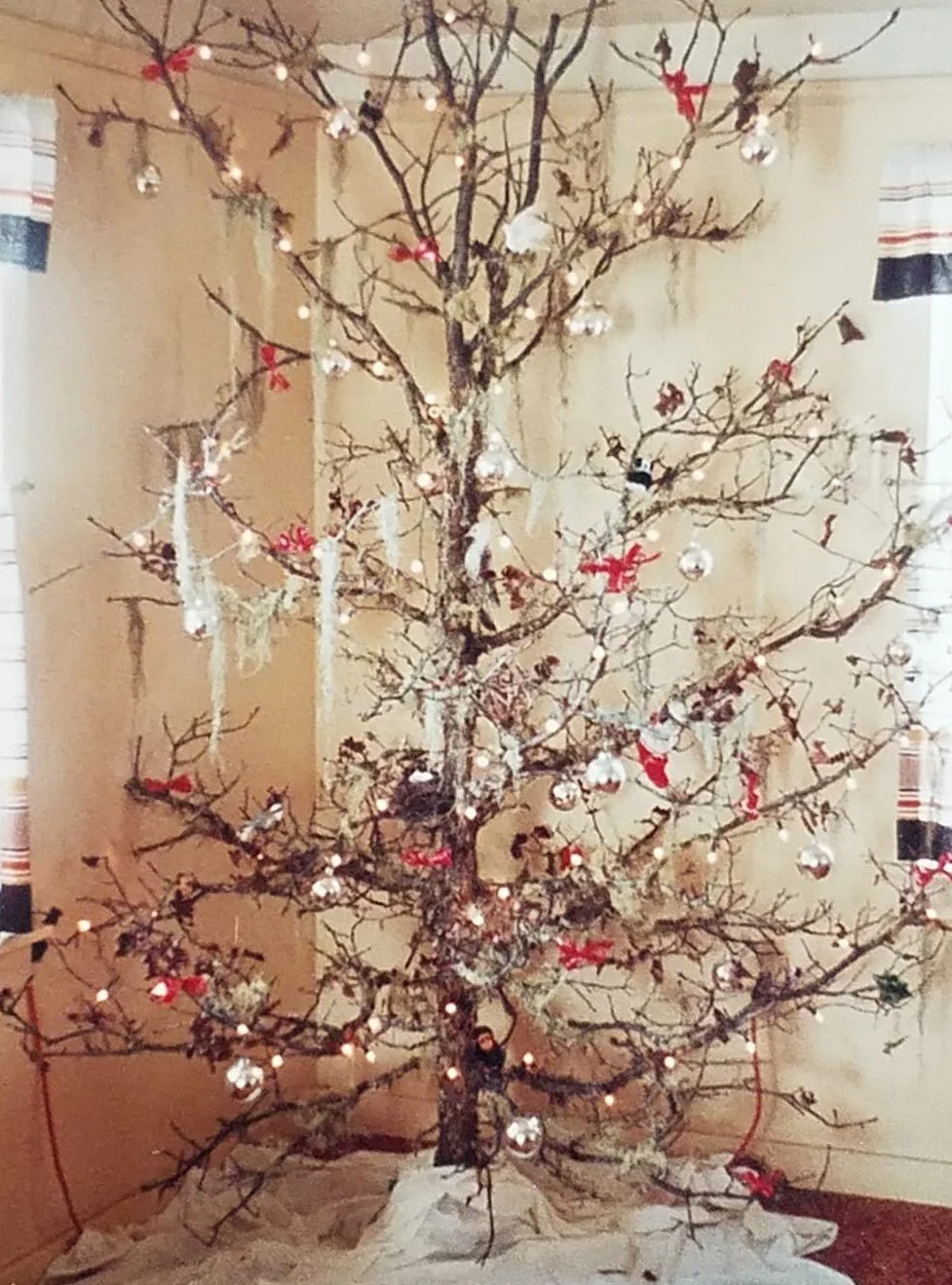
There’s nothing like the family hunt for the perfect Christmas tree.
You know the drill.
Mom and Dad load everyone up in the SUV, drive out to a local Christmas tree farm, and turn the gang loose. Fully garbed in knit hats, scarves, and crocheted mittens they traipse across frozen (or not so frozen) tundra in search of the ideal tree, the definition of which is as varied as: What do you want for Christmas?
And then the hollering begins from every corner of the tree lot.
“I found it!”
“Here it is!”
“This is the one!”
Eventually, the family gathers to scrutinize the choices, until—after much deliberation—a tree is chosen, with each family member acquiescing in varying degrees of approval or disappointment.
When I was a kid, I remember a few Christmas tree battles. My dad liked the Noble Fir with its tall sleek build and sparse branches to showcase the ornaments. My younger brother always wanted a Douglas Fir—triangular and filled with branches—the likes of which he lovingly referred to as “a big fat one.” Mom was always open to variety, and liked changing it up year after year. One year, we even had a totally white tree, fully flocked with fake snow.
But the most memorable tree of all was the one we got the Christmas of 1981.
A logger who attended my dad’s church invited our family to go pick a tree from his job site in the forest. He assured Dad there were plenty of suitable young trees to choose from. As a pastor on a tight budget, he jumped at the chance to get a free tree so on a nippy December afternoon, we loaded the family station wagon and drove out to the woods in search of the perfect Christmas tree.
As we stomped through the forest, we quickly discovered that trees in their natural habitat are not sculpted like the ones you find on a professional lot, so it was going to take a little imagination to find a tree that had any sort of traditional flare. My brothers pointed out several possibilities, but Mom and I weren’t sold on any of them. As we tromped between giant firs and low-growing ferns, I began to notice the beauty of the maple and oak trees with their bare winter- white branches, coated with hanging moss and silver lichen draped like lace. I kept imagining their potential as a non-traditional, but elegant adaptation of a Christmas tree. I told my mom, and she was thinking the same thing. But then she added, “We’ll never be able to convince the guys.”
And she was right.
Almost.
They thought we were joking.
They said we were nuts.
They shook their heads in disbelief.
Even my little sister was not so sure.
To this day, I don’t know how we talked them into it. Maybe they realized there were no “big fat ones” short enough to fit through the front door. Or, perhaps, it was the promise to let them pick the tree next year. Or, just maybe, it was the offer of warm sugar cookies and hot cocoa when we got home. Anything to get out of the cold. I don’t know, but Mom showed Dad the tree we wanted and he cut it and tied it to the top of the car.
My brothers were mortified.
Surely, the Grinch had just stole Christmas.
On the way home, I wondered if we had made a mistake. What if it didn’t look as good as we’d hoped? What if everyone made fun of our naked needless non-traditional tree?
At home, with it propped up in the corner, moss and lichen still attached, mom and I went to work.
White lights.
Silver balls
Red bows.
Little fake birds roosting in the branches.
The final touch: a real bird’s nest tucked up against the trunk.
No, it wasn’t green. No, it didn’t smell like pine. No, it wasn’t covered in all of the usual Christmas decorations and ornaments. It was one-of-a-kind with a beauty all of its own. Linus’s voice echoed in my mind. “I never thought it was such a bad little tree, Charlie Brown.”
My parents and I were excited to show the family friend the tree we’d chosen. My brothers, not so much.
When he walked in, he looked confused. “You couldn’t find a better tree than that?”
My brothers felt vindicated.
Mom and I laughed. “There were other trees, but this is what we liked the best.”
“Well, it sure is different.”
We couldn’t argue with that.
We got mixed reviews from family and friends that year. The picture at the top of the post is the actual tree, so you can decide for yourself, and I welcome your comments.
My brothers dubbed it: “The Dead Tree of Christmas Past,” and we still lovingly refer to it as that to this day.
There is something to be learned from that not-so-normal holiday tree, and it comes from the story of Christmas.
A fallen creation.
A need for a savior.
A manger.
A star.
Shepherds.
A king is born.
Worship.
It didn’t look like anyone imagined. A savior should ride in on a horse, a valiant warrior, powerful, heroic, strong. Not a helpless baby tucked away in a shabby stable, bundled in grave clothes, sleeping in a feed trough for cattle.
I think of the virgin Mary, put in a wonderous, but precarious position. Carrying the King of kings, the long-awaited Messiah, the Savior of man. Poor, unwed and pregnant. How people must have looked at her. The whispers. The accusations. How she must have felt, not knowing exactly what God had in mind, unsure what each day would bring. The massive weight of raising the Son of God.
The questions.
What was God doing?
Why did He choose her?
What did she have to offer?
Just like our winter-weary tree. God made in her a beauty that went far beyond what others could see. Her heart was humble, willing, devoted to the God she couldn’t see, but whom she trusted and believed. Mary’s song reflects her faith that God would fulfill His purposes in His plan for her life:
“My soul glorifies the Lord
and my spirit rejoices in God my Savior,
for he has been mindful
of the humble state of his servant.
From now on all generations will call me blessed,
for the Mighty One has done great things for me—
holy is his name.” (Luke 1:46-49).
God often chooses the lowly, the lesser than, the insignificant, the meek and displays His power in them to accomplish His will. The “Dead tree of Christmas past,” with its unexpected artistry and limbs that nested new life reminds us that death does not have the last word. That God is in the business of transforming lives, and He’s still at work in our world today. That God transforms, making all things new.
He brings beauty from ashes.
Hope from despair.
Life from death.
Christmas is so much more than the traditions we share—the tree we choose, the songs we sing, and the gifts we give. It’s a celebration of the redemptive heart of our Creator.
God.
Reaching down.
With mercy.
With love.
In an unexpected way.
To save the world.
Jen♡